Chapter 16 Function Creation & Errors
What You’ll Learn:
- Creating functions in R
- Function arguments and defaults
- Return values
- Common function creation errors
- Function documentation
Key Errors Covered: 18+ function errors
Difficulty: ⭐⭐ Intermediate to ⭐⭐⭐ Advanced
16.1 Introduction
Functions are fundamental to R programming, but creating them has pitfalls:
# Try to create a function
my_function <- function(x) {
  result <- x * 2
  # Forget to return!
}

my_function(5)  # Returns NULL!
Let’s master function creation to avoid these issues.
16.2 Function Basics
💡 Key Insight: Functions Are Objects
# Functions are first-class objects
my_func <- function(x) {
  x * 2
}

# It's an object
class(my_func)
#> [1] "function"
typeof(my_func)
#> [1] "closure"

# Can be passed around
apply_func <- function(f, value) {
  f(value)
}

apply_func(my_func, 5)
#> [1] 10

# Can be stored in lists
func_list <- list(
  double = function(x) x * 2,
  triple = function(x) x * 3
)

func_list$double(5)
#> [1] 10

# Can be returned from functions
make_multiplier <- function(n) {
  function(x) x * n
}

times_4 <- make_multiplier(4)
times_4(5)
#> [1] 20
Key points: - Functions are objects like any other - Can be assigned to variables - Can be passed as arguments - Can be returned from functions - Can be anonymous (unnamed)
16.3 Error #1: could not find function
⭐ BEGINNER 🔍 SCOPE
16.3.1 The Error
# Typo in function name
maen(c(1, 2, 3))
#> Error in maen(c(1, 2, 3)): could not find function "maen"
🔴 ERROR
Error in maen(c(1, 2, 3)) : could not find function "maen"16.3.2 What It Means
R can’t find a function with that name in the current environment or loaded packages.
16.3.3 Common Causes
16.3.4 Solutions
✅ SOLUTION 1: Check Spelling
# Use tab completion in RStudio
# Type first few letters and press Tab

# Check available functions
apropos("mean")  # Find functions with "mean" in name
#>  [1] ".colMeans"         ".rowMeans"         "calculate_mean"
#>  [4] "col_means"         "colMeans"          "cummean"
#>  [7] "group_means"       "image_fuzzycmeans" "kmeans"
#> [10] "mean"              "mean_cl_boot"      "mean_cl_normal"
#> [13] "mean_cpp"          "mean_r"            "mean_sdl"
#> [16] "mean_se"           "mean_val"          "mean.Date"
#> [19] "mean.default"      "mean.difftime"     "mean.POSIXct"
#> [22] "mean.POSIXlt"      "mpg_mean"          "my_mean"
#> [25] "my_mean_value"     "robust_mean"       "rollmean"
#> [28] "rollmean.default"  "rollmeanr"         "row_means_apply"
#> [31] "rowMeans"          "verbose_mean"      "weighted.mean"

# Search help
??mean
✅ SOLUTION 2: Load Required Package
# Check if function is in a package
help.search("ggplot")

# Load package
library(ggplot2)

# Or use package::function syntax
ggplot2::ggplot(mtcars, aes(x = mpg, y = hp))
✅ SOLUTION 3: Check Function Exists
16.4 Error #2: argument "x" is missing, with no default
⭐ BEGINNER 📋 ARGS
16.4.1 The Error
my_func <- function(x, y) {
  x + y
}

my_func(5)  # Missing y!
#> Error in my_func(5): argument "y" is missing, with no default
🔴 ERROR
Error in my_func(5) : argument "y" is missing, with no default16.4.3 Understanding Arguments
# Required arguments (no default)
func1 <- function(x, y) {
  x + y
}

func1(5, 10)  # Must provide both
#> [1] 15# Optional arguments (with default)
func2 <- function(x, y = 10) {
x + y
}
func2(5, 20) # Can override default
#> [1] 25
func2(5) # Uses default y = 10
#> [1] 15
# All optional
func3 <- function(x = 5, y = 10) {
x + y
}
func3() # Uses all defaults
#> [1] 15
func3(8) # Override x, use default y
#> [1] 18
func3(8, 12) # Override both
#> [1] 2016.4.4 Solutions
✅ SOLUTION 1: Provide All Required Arguments
✅ SOLUTION 2: Add Default Values
# Make some/all arguments optional
my_func <- function(x, y = 0) {
  x + y
}

my_func(5)     # Works, y defaults to 0
#> [1] 5
my_func(5, 10) # Can still override
#> [1] 15

# Can use NULL as default
my_func2 <- function(x, y = NULL) {
  if (is.null(y)) {
    y <- x  # Default to same as x
  }
  x + y
}

my_func2(5)
#> [1] 10
my_func2(5, 3)
#> [1] 8
✅ SOLUTION 3: Check Arguments
my_func <- function(x, y) {
  # Check if arguments provided
  if (missing(x)) {
    stop("Argument 'x' is required")
  }
  if (missing(y)) {
    message("Argument 'y' not provided, using default of 0")
    y <- 0
  }

  x + y
}

my_func(5)    # Warning but works
#> Argument 'y' not provided, using default of 0
#> [1] 5
my_func(5, 3)
#> [1] 816.5 Error #3: unused argument
⭐ BEGINNER 📋 ARGS
16.5.1 The Error
my_func <- function(x, y) {
  x + y
}

my_func(5, 10, 15)  # Too many arguments!
#> Error in my_func(5, 10, 15): unused argument (15)
🔴 ERROR
Error in my_func(5, 10, 15) : unused argument (15)16.5.4 Solutions
✅ SOLUTION 1: Remove Extra Arguments
✅ SOLUTION 2: Use … to Accept Extra Arguments
# Allow any number of additional arguments
my_func <- function(x, y, ...) {
  result <- x + y

  # Can pass ... to other functions
  extra_args <- list(...)
  if (length(extra_args) > 0) {
    message("Ignoring extra arguments: ",
            paste(names(extra_args), collapse = ", "))
  }

  result
}

my_func(5, 10)              # Works
#> [1] 15
my_func(5, 10, z = 15)      # Works, ignores z
#> Ignoring extra arguments: z
#> [1] 15
my_func(5, 10, 15, 20)      # Works, ignores unnamed extras
#> Ignoring extra arguments:
#> [1] 15
✅ SOLUTION 3: Validate Arguments
my_func <- function(x, y) {
  # Capture call
  call <- match.call()

  # Check for unexpected arguments
  valid_args <- c("x", "y")
  provided_args <- names(call)[-1]  # Remove function name

  invalid <- setdiff(provided_args, valid_args)
  if (length(invalid) > 0) {
    stop("Unexpected arguments: ", paste(invalid, collapse = ", "),
         "\nValid arguments are: ", paste(valid_args, collapse = ", "))
  }

  x + y
}

my_func(5, 10)
#> [1] 1516.6 Return Values
💡 Key Insight: Return Values
# Implicit return (last expression)
func1 <- function(x) {
  x * 2
}
func1(5)  # Returns 10
#> [1] 10

# Explicit return
func2 <- function(x) {
  return(x * 2)
}
func2(5)  # Returns 10
#> [1] 10

# Early return
func3 <- function(x) {
  if (x < 0) {
    return(0)  # Exit early
  }
  x * 2
}
func3(-5)  # Returns 0
#> [1] 0
func3(5)   # Returns 10
#> [1] 10

# No return (returns NULL)
func4 <- function(x) {
  result <- x * 2
  # Forgot to return or print result
}
func4(5)  # Returns NULL invisibly

# Multiple values (use list)
func5 <- function(x) {
  list(
    original = x,
    doubled = x * 2,
    squared = x^2
  )
}
func5(5)
#> $original
#> [1] 5
#>
#> $doubled
#> [1] 10
#>
#> $squared
#> [1] 25

# Return NULL explicitly
func6 <- function(x) {
  if (x < 0) {
    return(NULL)
  }
  x * 2
}
func6(-5)  # NULL
#> NULL
func6(5)   # 10
#> [1] 10
Best practices:
- Last expression is returned automatically
- Use return() for early exits
- Use invisible() for functions with side effects
- Return lists for multiple values
16.7 Error #4: object of type 'closure' is not subsettable
⭐⭐ INTERMEDIATE 🔢 TYPE
16.7.1 The Error
my_func <- function(x) x * 2

# Try to subset a function
my_func[1]
#> Error in my_func[1]: object of type 'closure' is not subsettable
🔴 ERROR
Error in my_func[1] : object of type 'closure' is not subsettable16.7.2 What It Means
You’re trying to subset a function as if it were a vector or list. “Closure” is R’s internal name for functions.
16.8 Function Arguments: … (Dots)
💡 Key Insight: The … Argument
# ... captures any additional arguments
my_plot <- function(x, y, ...) {
  plot(x, y, ...)  # Pass ... to another function
}

# Can pass any plot arguments
my_plot(1:10, 1:10, col = "red", pch = 16, main = "Test")

# Access ... contents
my_func <- function(...) {
  args <- list(...)
  cat("Received", length(args), "arguments\n")
  args
}

my_func(a = 1, b = 2, c = 3)
#> Received 3 arguments
#> $a
#> [1] 1
#>
#> $b
#> [1] 2
#>
#> $c
#> [1] 3

# Extract specific arguments from ...
my_func2 <- function(x, ...) {
  dots <- list(...)

  # Get specific argument
  if ("multiplier" %in% names(dots)) {
    mult <- dots$multiplier
  } else {
    mult <- 1
  }

  x * mult
}

my_func2(5)
#> [1] 5
my_func2(5, multiplier = 3)
#> [1] 15

# Common use: wrapper functions
my_mean <- function(..., na.rm = FALSE) {
  # Add custom behavior
  message("Calculating mean...")

  # Pass to base function
  mean(..., na.rm = na.rm)
}

my_mean(c(1, 2, NA, 4), na.rm = TRUE)
#> Calculating mean...
#> [1] 2.333333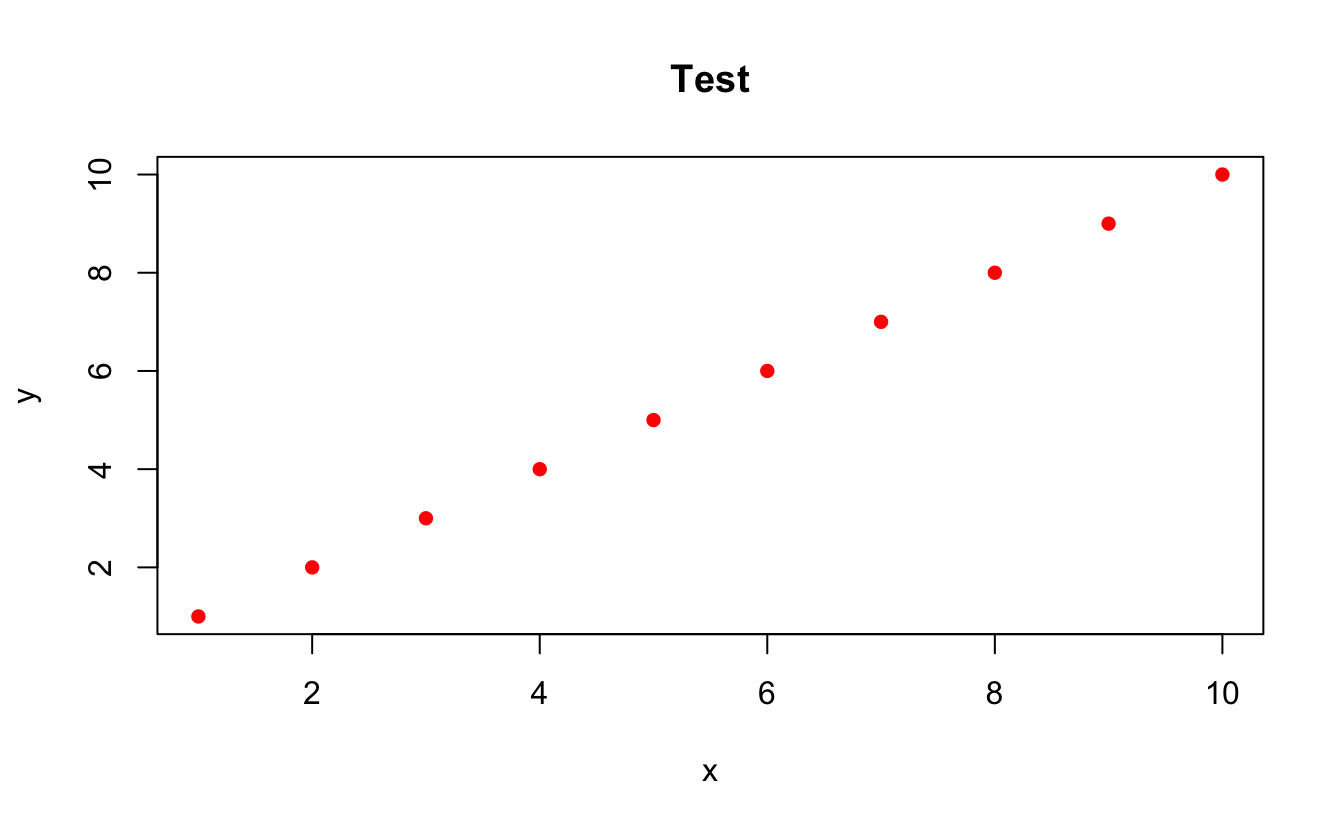
When to use …: - Wrapper functions (pass args to another function) - Flexible functions (accept varying arguments) - Methods (S3/S4 generics often use …)
Caution: - Arguments after … must be named explicitly - Easy to make typos that go unnoticed
16.9 Argument Matching
💡 Key Insight: How R Matches Arguments
my_func <- function(first, second, third) {
  cat("first:", first, "\n")
  cat("second:", second, "\n")
  cat("third:", third, "\n")
}

# 1. Exact name match
my_func(first = 1, second = 2, third = 3)
#> first: 1
#> second: 2
#> third: 3

# 2. Partial name match (not recommended!)
my_func(f = 1, s = 2, t = 3)
#> Warning in my_func(f = 1, s = 2, t = 3): partial argument match of 'f' to
#> 'first'
#> Warning in my_func(f = 1, s = 2, t = 3): partial argument match of 's' to
#> 'second'
#> Warning in my_func(f = 1, s = 2, t = 3): partial argument match of 't' to
#> 'third'
#> first: 1
#> second: 2
#> third: 3

# 3. Positional match
my_func(1, 2, 3)
#> first: 1
#> second: 2
#> third: 3

# 4. Mixed (named don't need to be in order)
my_func(third = 3, first = 1, second = 2)
#> first: 1
#> second: 2
#> third: 3
my_func(1, third = 3, second = 2)
#> first: 1
#> second: 2
#> third: 3

# Order of matching:
# 1. Exact name matches
# 2. Partial name matches
# 3. Positional matches
Best practices: - Use exact names for clarity - Avoid partial matching (can cause confusion) - Use names for all arguments after the first few - Named arguments can be in any order
16.10 Common Function Patterns
🎯 Best Practice: Function Patterns
# 1. Validate inputs
safe_divide <- function(x, y) {
  # Check types
  if (!is.numeric(x) || !is.numeric(y)) {
    stop("Both x and y must be numeric")
  }

  # Check values
  if (any(y == 0)) {
    stop("Cannot divide by zero")
  }

  x / y
}

safe_divide(10, 2)
#> [1] 5# 2. Provide informative messages
verbose_mean <- function(x, na.rm = FALSE, verbose = TRUE) {
if (verbose) {
message("Calculating mean of ", length(x), " values")
if (na.rm) {
message("Removing NA values")
}
}
mean(x, na.rm = na.rm)
}
verbose_mean(c(1, 2, NA, 4), na.rm = TRUE)
#> Calculating mean of 4 values
#> Removing NA values
#> [1] 2.333333
# 3. Handle edge cases
robust_max <- function(x) {
if (length(x) == 0) {
return(NULL)
}
if (all(is.na(x))) {
return(NA)
}
max(x, na.rm = TRUE)
}
robust_max(numeric(0))
#> NULL
robust_max(c(NA, NA))
#> [1] NA
robust_max(c(1, 2, NA, 3))
#> [1] 3
# 4. Return useful objects
detailed_summary <- function(x) {
result <- list(
mean = mean(x, na.rm = TRUE),
median = median(x, na.rm = TRUE),
sd = sd(x, na.rm = TRUE),
n = length(x),
n_missing = sum(is.na(x))
)
class(result) <- "detailed_summary"
result
}
summary_obj <- detailed_summary(c(1, 2, NA, 4, 5))
summary_obj
#> $mean
#> [1] 3
#>
#> $median
#> [1] 3
#>
#> $sd
#> [1] 1.825742
#>
#> $n
#> [1] 5
#>
#> $n_missing
#> [1] 1
#>
#> attr(,"class")
#> [1] "detailed_summary"
# 5. Use ... appropriately
flexible_plot <- function(x, y, type = "p", ...) {
# Set defaults
defaults <- list(
pch = 16,
col = "blue"
)
# Override with ...
args <- modifyList(defaults, list(...))
# Call plot
do.call(plot, c(list(x = x, y = y, type = type), args))
}
flexible_plot(1:10, 1:10, col = "red", main = "Test")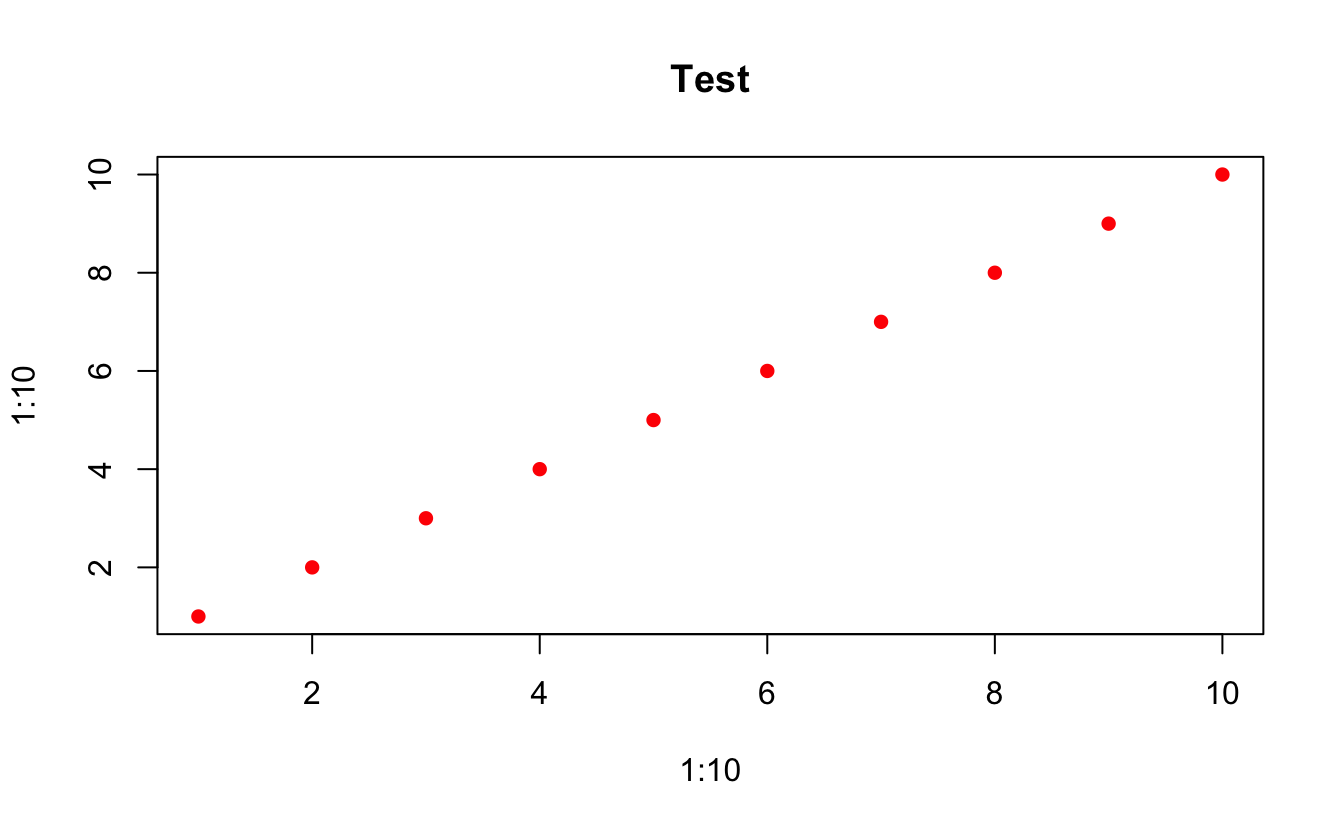
16.11 Documentation
🎯 Best Practice: Document Your Functions
#' Calculate the area of a circle
#'
#' @param radius Numeric. The radius of the circle.
#' @param units Character. The units of measurement (default: "cm").
#' @return Numeric. The area of the circle.
#' @examples
#' circle_area(5)
#' circle_area(10, units = "inches")
#' @export
circle_area <- function(radius, units = "cm") {
  if (!is.numeric(radius) || radius < 0) {
    stop("radius must be a non-negative number")
  }

  area <- pi * radius^2

  structure(
    area,
    units = units,
    class = c("circle_area", "numeric")
  )
}

# In-function comments
calculate_price <- function(base_price, tax_rate = 0.1, discount = 0) {
  # Validate inputs
  if (base_price < 0) stop("base_price cannot be negative")
  if (tax_rate < 0 || tax_rate > 1) stop("tax_rate must be between 0 and 1")
  if (discount < 0 || discount > 1) stop("discount must be between 0 and 1")

  # Apply discount
  discounted_price <- base_price * (1 - discount)

  # Add tax
  final_price <- discounted_price * (1 + tax_rate)

  # Return itemized result
  list(
    base_price = base_price,
    discount = discount,
    discounted_price = discounted_price,
    tax = discounted_price * tax_rate,
    final_price = final_price
  )
}
16.12 Summary
Key Takeaways:
- Functions are objects - Can be assigned, passed, returned
- could not find function - Check spelling, loading, scope
- Provide required arguments - Or add defaults
- Don’t pass extra arguments - Unless function uses …
- Last expression is returned - Or use return() explicitly
- closure not subsettable - You’re trying to subset a function
- Use … for flexibility - Pass extra args to other functions
- Validate inputs - Check types and values
Quick Reference:
| Error | Cause | Fix |
|---|---|---|
| could not find function | Typo, not loaded, not defined | Check spelling, load package |
| argument missing | Required arg not provided | Provide arg or add default |
| unused argument | Too many args | Remove extra or use … |
| closure not subsettable | Subsetting a function | Call function or use right object |
Function Creation:
# Basic function
my_func <- function(x, y) {
  x + y
}

# With defaults
my_func <- function(x, y = 0) {
  x + y
}

# With ...
my_func <- function(x, ...) {
  # Do something
  other_func(x, ...)
}

# With validation
my_func <- function(x) {
  if (!is.numeric(x)) stop("x must be numeric")
  x * 2
}

# Return values
my_func <- function(x) {
  list(result = x * 2, original = x)
}
Best Practices:
# ✅ Good
function(x, y = 0)              # Sensible defaults
if (!is.numeric(x)) stop()      # Validate inputs
return(list(a = 1, b = 2))      # Multiple values in list
Use descriptive names            # clear_cache() not cc()

# ❌ Avoid
function(x)                     # No defaults when optional
No input validation             # Causes cryptic errors later
mean <- my_data                 # Overwriting function names
function(x, y, z, a, b, c)      # Too many arguments
16.13 Exercises
📝 Exercise 1: Safe Division Function
Write safe_divide(x, y) that:
1. Checks both are numeric
2. Handles division by zero
3. Works with vectors
4. Returns informative errors
📝 Exercise 2: Flexible Summary
Write my_summary(x, ...) that:
1. Calculates mean, median, sd
2. Accepts … for additional stats
3. Handles NA values
4. Returns named list
📝 Exercise 3: Argument Validator
Write validate_args(func, ...) that:
1. Checks if function exists
2. Validates argument types
3. Checks required args provided
4. Returns TRUE/FALSE with messages
16.14 Exercise Answers
Click to see answers
Exercise 1:
safe_divide <- function(x, y) {
  # Check types
  if (!is.numeric(x)) {
    stop("x must be numeric, got ", class(x)[1])
  }
  if (!is.numeric(y)) {
    stop("y must be numeric, got ", class(y)[1])
  }

  # Check for zero
  if (any(y == 0)) {
    warning("Division by zero detected, returning Inf/-Inf")
    # R handles this naturally, but we warn
  }

  # Check lengths match or can recycle
  if (length(x) != length(y) && length(x) != 1 && length(y) != 1) {
    if (max(length(x), length(y)) %% min(length(x), length(y)) != 0) {
      warning("Lengths not compatible for recycling: ",
              length(x), " and ", length(y))
    }
  }

  result <- x / y
  result
}

# Test
safe_divide(10, 2)
#> [1] 5
safe_divide(c(10, 20, 30), c(2, 4, 5))
#> [1] 5 5 6
safe_divide(10, 0)  # Warning
#> Warning in safe_divide(10, 0): Division by zero detected, returning Inf/-Inf
#> [1] InfExercise 2:
my_summary <- function(x, ..., na.rm = TRUE) {
  # Base statistics
  result <- list(
    n = length(x),
    n_missing = sum(is.na(x)),
    mean = mean(x, na.rm = na.rm),
    median = median(x, na.rm = na.rm),
    sd = sd(x, na.rm = na.rm),
    min = min(x, na.rm = na.rm),
    max = max(x, na.rm = na.rm)
  )

  # Additional statistics from ...
  extra_stats <- list(...)

  for (stat_name in names(extra_stats)) {
    stat_func <- extra_stats[[stat_name]]
    if (is.function(stat_func)) {
      result[[stat_name]] <- stat_func(x, na.rm = na.rm)
    }
  }

  class(result) <- "my_summary"
  result
}

# Print method
print.my_summary <- function(x, ...) {
  cat("Summary Statistics\n")
  cat("==================\n")
  for (name in names(x)) {
    cat(sprintf("%-12s: %s\n", name,
                format(x[[name]], digits = 3)))
  }
  invisible(x)
}

# Test
data <- c(1, 2, NA, 4, 5, 6, 7, 8, 9, 10)
my_summary(data)
#> Summary Statistics
#> ==================
#> n           : 10
#> n_missing   : 1
#> mean        : 5.78
#> median      : 6
#> sd          : 3.07
#> min         : 1
#> max         : 10

# With extra stats
my_summary(data,
          IQR = IQR,
          mad = mad)
#> Summary Statistics
#> ==================
#> n           : 10
#> n_missing   : 1
#> mean        : 5.78
#> median      : 6
#> sd          : 3.07
#> min         : 1
#> max         : 10
#> IQR         : 4
#> mad         : 2.97
Exercise 3:
validate_args <- function(func_name, ...) {
  # Check function exists
  if (!exists(func_name, mode = "function")) {
    message("✗ Function '", func_name, "' not found")
    return(FALSE)
  }

  func <- get(func_name, mode = "function")
  func_args <- formals(func)

  # Get provided arguments
  provided <- list(...)

  # Check required arguments (those without defaults)
  required_args <- names(func_args)[sapply(func_args,
                                           function(x) class(x) == "name")]

  missing_required <- setdiff(required_args, names(provided))

  if (length(missing_required) > 0) {
    message("✗ Missing required arguments: ",
            paste(missing_required, collapse = ", "))
    return(FALSE)
  }

  # Check for unexpected arguments
  if (!"..." %in% names(func_args)) {
    unexpected <- setdiff(names(provided), names(func_args))
    if (length(unexpected) > 0) {
      message("✗ Unexpected arguments: ",
              paste(unexpected, collapse = ", "))
      return(FALSE)
    }
  }

  # Check argument types (basic)
  for (arg_name in names(provided)) {
    arg_value <- provided[[arg_name]]
    # Could add more sophisticated type checking here
  }

  message("✓ All validations passed for '", func_name, "'")
  return(TRUE)
}

# Test
validate_args("mean", x = c(1, 2, 3), na.rm = TRUE)
#> ✗ Missing required arguments: ...
#> [1] FALSE
validate_args("mean", na.rm = TRUE)  # Missing x
#> ✗ Missing required arguments: x, ...
#> [1] FALSE
validate_args("mean", x = c(1, 2, 3), invalid = TRUE)  # Extra arg
#> ✗ Missing required arguments: ...
#> [1] FALSE
Exercise 4:
make_adder <- function(n) {
  # Return a function that adds n
  function(x) {
    x + n
  }
}

# Test
add_5 <- make_adder(5)
add_5(10)
#> [1] 15

add_100 <- make_adder(100)
add_100(50)
#> [1] 150

# Multiple uses
add_5(1:10)
#>  [1]  6  7  8  9 10 11 12 13 14 15

# Each function retains its own n
add_5(5)
#> [1] 10
add_100(5)
#> [1] 105

# More advanced: with validation
make_adder_safe <- function(n) {
  if (!is.numeric(n) || length(n) != 1) {
    stop("n must be a single numeric value")
  }

  function(x) {
    if (!is.numeric(x)) {
      stop("x must be numeric")
    }
    x + n
  }
}

add_3 <- make_adder_safe(3)
add_3(10)
#> [1] 13